
The number one complaint clients file against their attorneys isn’t bad legal work: it’s poor communication. CruxChat turns every client conversation into the communication your practice is judged on.
Built for conversations with high stakes, high emotion, and no room for “that’s not what I said.”
I.The stakes
These aren’t inconveniences. They’re the trust-eroding failures that cost referrals. Each one has a specific answer.
Every glance at your legal pad is a moment your client feels unheard, in the meetings where being heard is most of what they came for.
Record the conversation. Stay fully present.Weeks later, memories diverge. Without a shared record, every disagreement about what was discussed becomes your word against theirs.
A client summary both sides can point to, every line traceable to the recording.You brief your paralegal from memory. Details drop in the handoff, and the client repeats their story to every person who touches the file.
Everyone works from the same conversation, each in the form their role needs.The deadline mentioned in passing at minute forty is the one that surfaces in a fee dispute, or a bar complaint.
Action items extracted automatically. Nothing rides on your notes.II.The system
A generic meeting tool summarizes your client conversation the way a student answers an assignment with no rubric: it might include what you need or… it might not. A summary that silently dropped an important detail looks just like one that didn’t.
CruxChat works from instructions you write in plain English. Tell it what every reader needs in their summary, and that rubric governs every summary it produces.
And because different readers need different things from the same conversation, one recording produces three documents: strategic case notes for you, an action list for your paralegal, and a plain-English summary your client can actually use.
Every claim shows its work: each point in a summary cites the exact moment in the recording it came from, so confirming anything takes one click. Review client summaries with citations in place, then strip them with one click so the client gets what they need. Below are three examples for different readers from the same intake conversation:
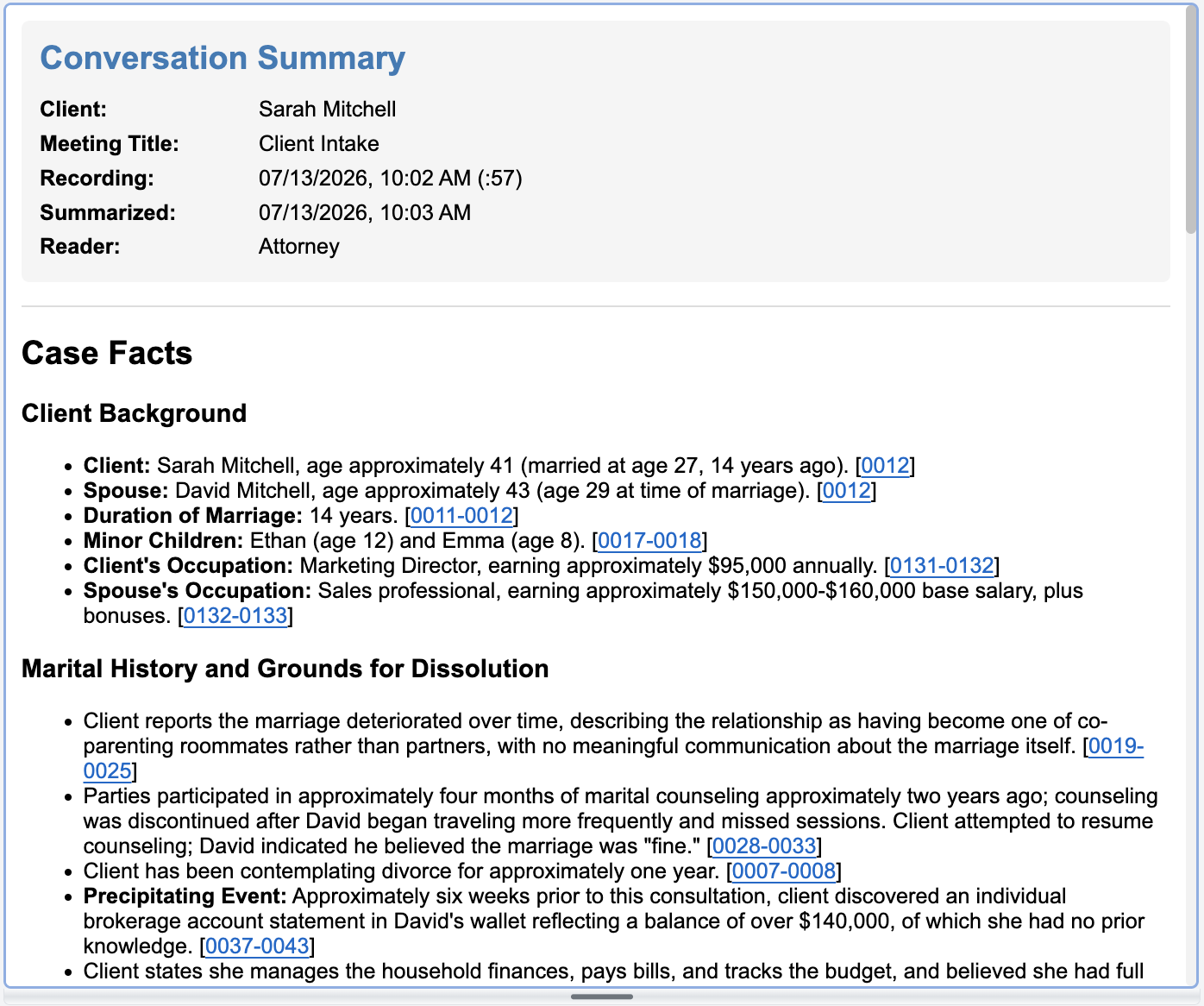
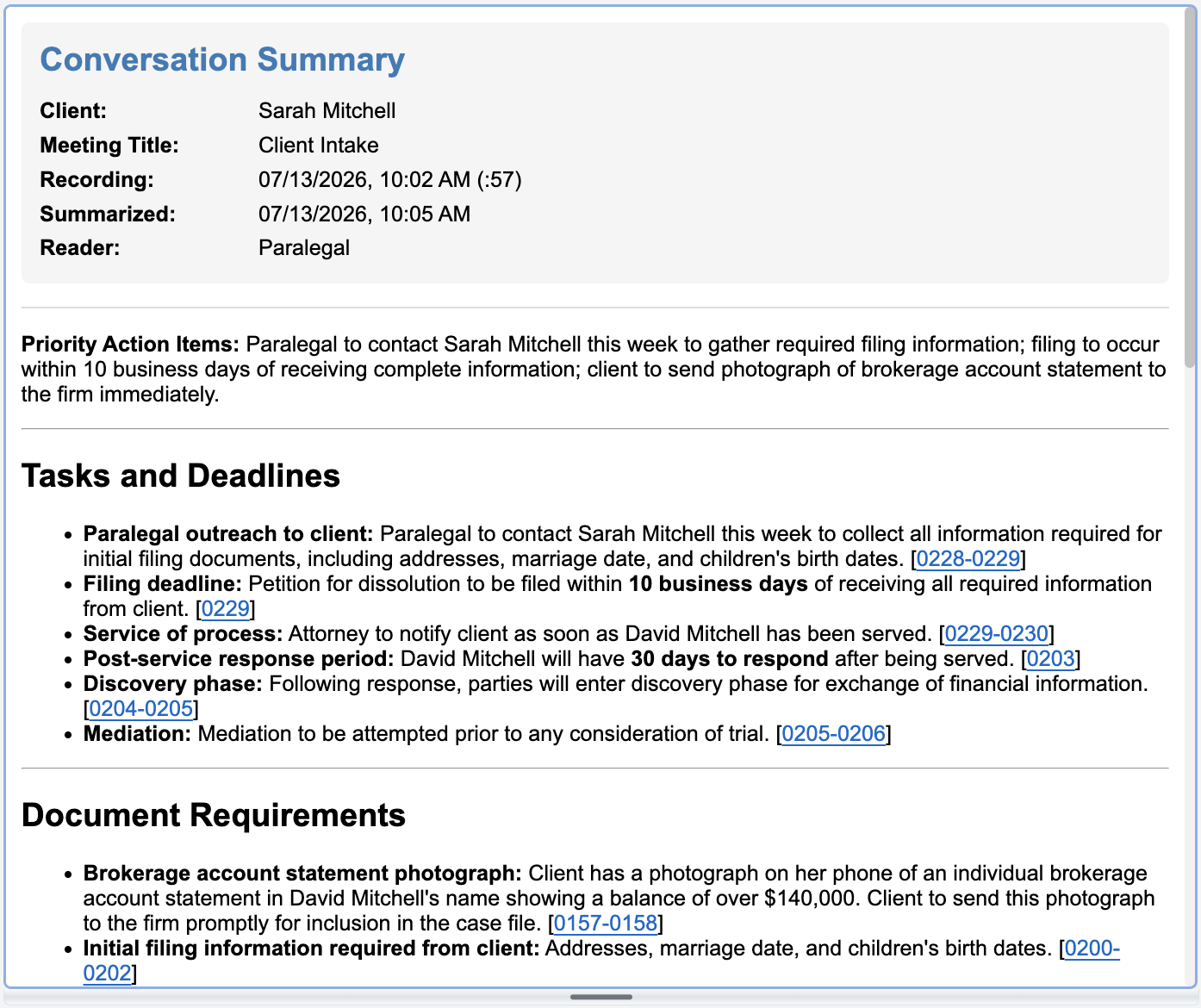
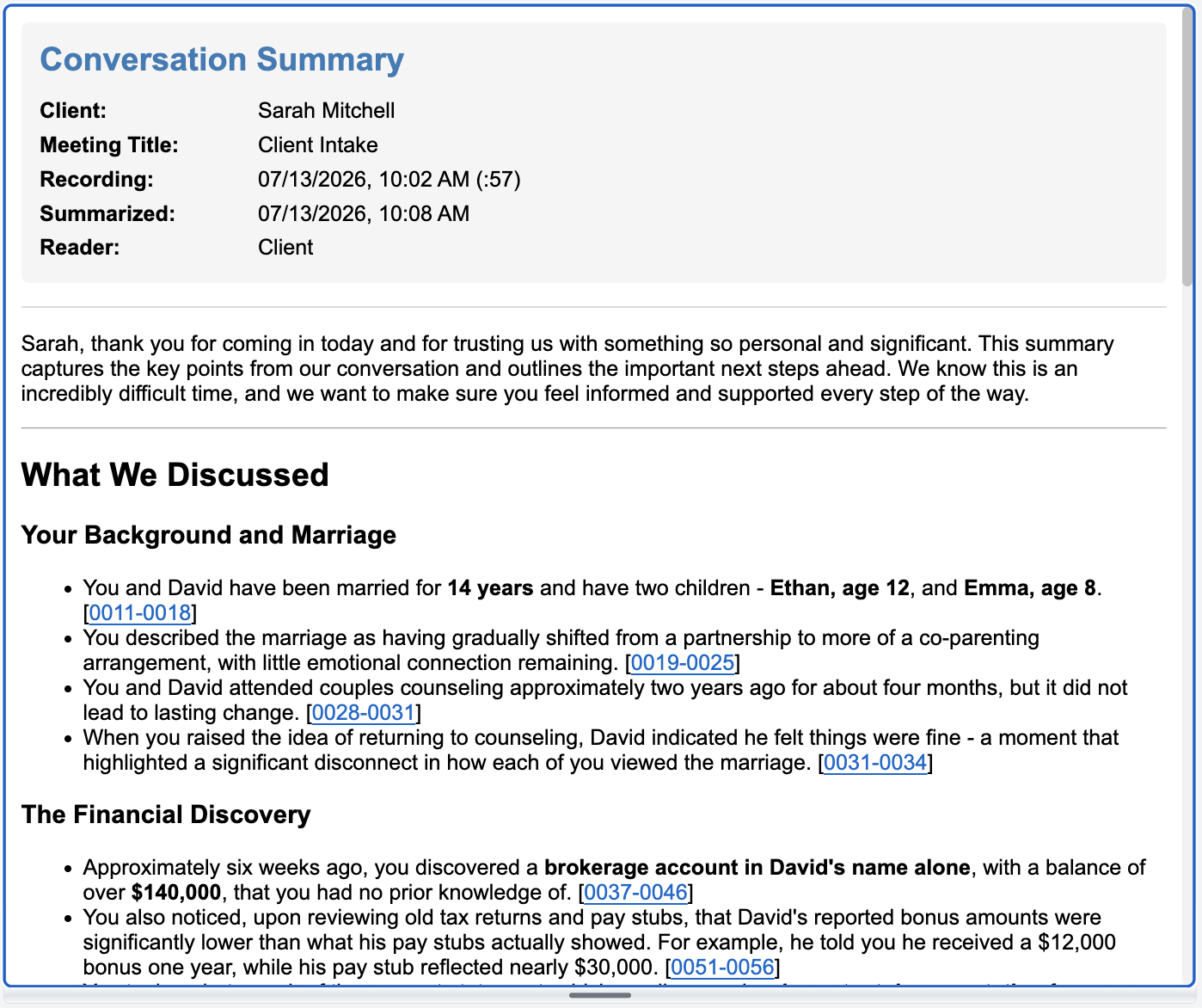
A single fictional intake. Three documents, each in the language its reader needs, generated in under two minutes. About 20 minutes of after-meeting documentation replaced by a nine-minute review, client summary included. Add additional readers as your needs evolve.
III.The specifics
| CruxVerify | Attorney review of every summary is required, and re-reading an hour of conversation to confirm a page of notes is the slowest step in the workflow. CruxVerify checks any summary, your edits included, against the original conversation, with annotations that point your review to exactly the right lines. |
|---|---|
| CruxAgenda | The missed topic surfaces after the client is gone, and now it’s a phone call, a delay, or a gap in the file. Walk in with the list of what must be covered, and CruxChat confirms what was addressed, and what wasn’t, before the client leaves the building. |
| Granular sharing | Sharing a matter has meant all or nothing: forward everything, or re-brief by hand. Share exactly what you choose: the client summary without the audio, or the full record to co-counsel. Nothing travels that you didn’t intend. |
| Case history recall | Preparing for mediation means reconstructing months of conversations to answer one question: was the client ever told this? For matters you keep in encrypted cloud storage, ask the question directly and get an answer with attribution to the specific conversation and moment. |
| 46 languages | When a client isn’t fluent in English, the choice has been to turn them away or let a relative translate a conversation that should stay privileged. CruxChat auto-detects the spoken language, transcribes and summarizes in 46 of them, including Spanish and Somali, and any report translates on demand. The client reads their summary in their language; you read your case notes in yours. |
| Under two minutes | Documentation written at the end of the day loses the details that mattered at ten in the morning. Summaries are ready before the client reaches the parking lot, and back-to-back consultations queue automatically so the next meeting can start while the last one processes. |
IV.The practice
No practice area combines high emotion, high stakes, and high documentation burden like family law. Custody arrangements, financial disclosures, safety concerns, filing deadlines, all surfacing in conversations where your client may be at the hardest moment of their life, and where your full attention is the service they’re paying for.
Family law is where CruxChat runs deepest: personas tuned to capture custody details and financial commitments, client summaries that de-escalate instead of confuse, and a verified record for the conversations most likely to be remembered differently by each party. For collaborative and flat-fee practices, every recovered hour is margin, not just relief. We demonstrated it live at the Family Law Institute 2026.
Family meetings where every sibling hears something different. A verified record of who decided what, and a plain-English summary each family member takes home.
Your client’s account, captured accurately the first time it’s told, when it’s freshest and it matters most. Flat-fee defense work keeps every recovered hour.
Case value lives in intake detail. Capture the full account at volume, with nothing lost between the first conversation and the demand letter.
V.The value
The return depends on how you bill. Here are the examples for flat-fee and hourly models.
| Today | With CruxChat | |
|---|---|---|
| Client conversations per day | 4 | 4 |
| Documentation, handoff & client summary | ~20 min | ~9 min |
| Conversation overhead per month | ~27 hrs | ~12 hrs |
Time gained: ~15 hours a month
Flat-fee firms buy efficiency. Fifteen hours is capacity: room for another matter each quarter. Or keep the same caseload and stop writing up your case notes at 9 PM.
Hourly firms buy differentiation. If you bill for documentation time, saving it isn’t new revenue. What changes is the staff and client experience: your internal operations run smoother, and clients feel informed, empowered, and confident. That’s the feeling that generates referrals.
Clients don’t recommend an attorney because the legal advice was good. That’s expected. They recommend the one who made them feel heard, understood, and informed.
VI.The vault
Conversations are deleted from our servers once processing completes. Storage is a choice you make, not a default you discover.
Choose cloud storage and add a passphrase, and it becomes unreadable by us and unrecoverable without you. You decide the tradeoff.
Your conversations are never used to train AI models. Not ours, not anyone’s. Contractually.
Built around the ABA’s formal guidance on generative AI in legal practice: competence, confidentiality, and supervision.
Every summary is reviewed by an attorney before it goes anywhere, so we built that step into the product. Citations tie each point to its moment in the recording, and CruxVerify checks any summary (your edits included) against the original conversation. Complete the review ABA 512 expects in a fraction of the time you would normally spend.
Request a demo
Gain the insight to serve every stakeholder. Earn the trust that builds your practice.
A 30-minute demo, built around the conversation you choose. If you like what you see, your first 30 days are free.